what were stalins goals and what steps did he take to achieve them?
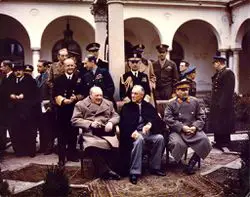
Stalin, Roosevelt and Churchill in 1945
What were the goals Stalin and the Soviet Union in the aftermath of the Second World State of war? The Soviet Supreme leader was an incredibly ambitious man and hoped to expand the Soviet Empire, later the defeat of the Third Reich and the Empire of Japan. Stalin sought to accomplish four specific objectives. Afterward the calamity of World War Two, he wanted to ensure the security of the Soviet Union, the expansion of Communism beyond the Soviet Union, secure his position in world diplomacy and create of a Soviet empire. As he set out to secure each of these goals in the wake of World War 2, he laid the foundations for the Cold War.
Securing Soviet borders at Tehran Briefing
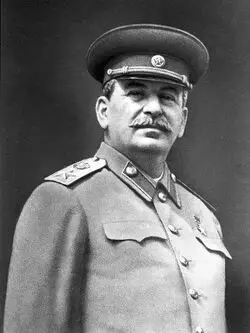
Stalin skillfully started to jostle for his regime's post-war position, while he and the western allies were engaged in an all-out war with Germany. Between Nov 28 and December 1, 1943, Stalin took part in the Tehran Conference. The chief discussion of the meeting, held by the US President Franklin Roosevelt, British Prime Minister Winston Churchill and Stalin, centered on the opening of a "2nd front" in Western Europe.
Stalin agreed to conduct eastern offensive operations to coincide with the forthcoming Western Front, and in render, he asked the western leaders to proceed with formal preparations for their long-promised invasion and regaining of German-occupied French republic. Stalin also insisted on retaining the territories provided by the German-Soviet Non-assailment Pact of 1939 and additionally requested the Baltic coast of East Prussia as a compensation for the USSR's enormous role and a greater number of casualties. [1]
The western allies, especially Churchill, did not similar what Stalin proposed and saw it every bit opportunistic, they reluctantly agreed to Stalin'south demands as they needed the Soviet Spousal relationship to defeat the Tertiary Reich. [2] In May 1944, in accord with the decisions fabricated at the Tehran Conference, Britain and U.s. troops launched an invasion of France, opening the so-called "2d front" in the West. Their actions allowed the Soviet Union to make meaning advances beyond Eastern Europe toward Germany. In detail, they avant-garde into the territories that they had lost during the German invasion. It was becoming clear that Deutschland was about defeat and that the geopolitical situation was going to quickly change. Churchill, Roosevelt and Stalin needed to meet once again to sort out the future of Europe. [3]
Cement territorial and political gains at Yalta
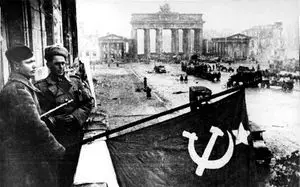
Soviet soldiers in Berlin in 1945
The Yalta Briefing took place in February 1945. This was the second wartime meeting of the "Big Three" the British Prime number Minister Winston Churchill, Soviet Premier Joseph Stalin, and United states President Franklin Roosevelt). Each brought his agenda to the Yalta Conference. The British wanted to maintain their empire, the Soviets wished to secure and obtain more land and secure positions in their new zones of influence and interests, and the US wanted to ensure the Soviet'southward entry into the Pacific war and discuss postwar settlement.[4]
From the very opening, Stalin fabricated it clear that his demands regarding Poland were not negotiable: the Soviets were to proceeds "their territory" from the eastern portion of Poland. Poland was to compensate for that past extending its Western borders, thereby forcing out millions of Germans. Negotiators even signed a declaration forcing the Shine to provide inclusion of Soviet Communists in their postwar national government.[5]
Moreover, Roosevelt master goal was to obtain a delivery from Stalin to participate in the United Nations to secure future peace and alliance. As for the other Eastern European countries, the Americans and the British more often than not agreed that the future governments of the nations bordering the Soviet Union should be "friendly" to the Soviet government as long as the Soviets pledged to allow gratuitous elections in all territories liberated from Germany.[6] Unfortunately, neither Poland nor any other Eastern European land had the opportunity of holding free elections for the adjacent 45 years.[7]
Furthermore, the Big Three agreed to require Germany'south unconditional surrender and ratified their agreements regarding Germany's postwar division: at that place were to be 4 zones of occupation, one zone for each of the three dominant nations plus one zone for French republic. Berlin itself, although within the Soviet zone, would besides be divided into four sectors, and would eventually become a major symbol of the Common cold War socialists-capitalists separation due to the infamous Berlin Wall, which was constructed and maintained by the Soviets.
The Soviets led past Stalin were keen on regaining lost territories, and the Yalta Conference was their best chance to do that. As a result, Stalin even agreed to enter the Pacific war confronting Japan in exchange for more territories granted, including portions of Sakhalin, Port Arthur, Manchurian railroads and the Kurile Islands.[8] Notwithstanding, already in poor wellness, President Roosevelt failed to acknowledge Stalin'south true objectives. Roosevelt readily met Stalin'south conditions, since the Soviets somewhen agreed to join the United nations and Pacific war. The two leaders even secretly negotiated a voting formula with a veto power granted solely to the permanent members on the UN Security Council, providing themselves with more control in the world affairs and greatly weakening the UN power in the oncoming disputes. Overall, Roosevelt and the other Allies felt confident that Yalta had been successful. Withal, the true Conference winner was once again Joseph Stalin.[ix]
Postal service war doctrines, conference reactions and consequences
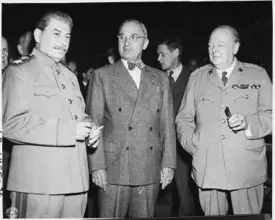
Stalin, Truman, and Churchill at Potsdam Conference in 1945
Although the initial reaction to the Yalta agreements was celebratory, information technology was also very brusque lived. In 1945, the assistants of the new Us president Harry Truman clashed with the Soviets over their influence in Eastern Europe and the United nations. Many Americans began to criticize Roosevelt's handling of the Yalta negotiations due to the following lack of Soviet cooperation and even giving Eastern Europe and Northeast Asia away to the Soviet Union.[ten] Numerous Primal European nations also regard the Briefing in Yalta as the "Great Western betrayal" since it immune the USSR to intervene freely in their domestic affairs, abandoning democratic policies and turning them into Soviet satellites.
Yalta effectively immune the USSR to install Communist regimes in Fundamental Europe with impunity. At the Yalta briefing, the Big Three "attempted to sacrifice liberty for the sake of stability," and many believe the decisions and concessions of Roosevelt and Churchill during the elevation led to the following power struggle during the Cold State of war. Nevertheless, Stalin essentially got everything he wanted: a significant territorial sphere of influence and involvement as a buffer zone.
The German invasion in, the USSR and pressing back to victory in the East required a tremendous sacrifice by the Soviet Spousal relationship. And Stalin skillfully used that during the wartime conferences in pursuit of his postwar Soviet empire expansion. Soviet military casualties totaled approximately 35 one thousand thousand with over 15 million killed, missing or captured. One in four Soviets was killed or wounded. More than than 1,700 towns and lxx,000 villages were destroyed, and the Soviet civilian decease toll reached over 25 million.[11]
Thereafter, Stalin was often referred to as one of the almost influential men in homo history. Although Stalin was responsible for the deaths of over 20 million people during his brutal rule, he was even nominated for Nobel Peace Prize twice – in 1945 and 1948.[12] He connected to prosecute a reign of terror, purges, executions, exiles to labor camps and persecution in the postwar USSR, suppressing all dissent and anything that represented strange–especially Western–influence. One of the cardinal aims of Stalin, earlier and after the war was the retentivity of his won power and to make himself secure against all his existent or imagined opponents.[13] Nonetheless, despite all, Soviet dictator's iron will and deft political skills allow Stalin play the loyal ally while never abandoning his vision of an expanded postwar Soviet empire.

Constitute Soviet-style Regimes in Eastern Europe at war'south end
Stalin prime number aim at the various wartime conferences and in the firsthand aftermath of the war, it has been argued was the defense of the Soviet Matrimony. The Communist state had suffered profoundly during the war and had suffered millions of casualties. Furthermore, Russian federation had been invaded during the First World War and had been invaded many times in its history. Stalin, a fundamental pupil of history, was very aware of this and he wanted to protect the Soviet Matrimony, from further invasions. This partly explained his inexhaustible hunger for land and territory.[14] Stalin may have driven the Germans from eastern Europe, and subsequently a cursory state of war collection the Japanese out of Northern Communist china and Northern Korea, however, he did non gratuitous these countries. In upshot, these countries had communist regimes imposed on them. Local communists were elevated to positions of power in the liberated regions and nations and with the support of Stalin, they eventually became part of the Communist Bloc, which was led by Stalin, in Moscow.
Stalin was eager to extend the territories under his control to establish friendly nations on his borders.[15] The Soviet Supreme leader knew that if friendly governments ruled the territories surrounding his country, that they would be less likely to aid any enemy in attacking Russia. Furthermore, Stalin wanted friendly governments around his nation, to human action as a buffer and to protect the Soviet Spousal relationship from any invasion. Stalin besides wanted to control countries that traditionally had threatened the Soviet Union, such as Poland and Germany.
This effort was all done to protect the Soviet Union from further attacks and invasions, especially from his former allies, the British and the Americans. He, like other communists, believed that a confrontation between the Communist system and the Capitalist system was inevitable.[16]
Expansion of Communism
Stalin is often portrayed equally a blood-thirsty and power-mad dictator. This is true, but he was also a committed communist and was a firm believer in the tenets of Marxism-Leninism. This Communist doctrine foresaw a global revolution in which all the nations of the world would become communists and holding and wealth would be distributed equally. The ultimate aim of Communism was to reform lodge and transform humanity by the common sharing of goods, which would end exploitation and conflict. Stalin had previously favored developing communism in the Soviet Union, in opposition to the call of Trotsky, to export communist revolution around the world. By 1944-1945, Stalin was well enlightened that the Red Army and its victories immune an unprecedented opportunity to expand Communism.[17] This led him to adopt the policy of supporting Communist parties in eastern Europe.
In the years after the Soviet liberation of countries, such equally Bulgaria, Romania, and Hungary, the Soviet Supreme leader, staged coups that deposed often democratically elected governments, usually pro-western and replaced them with Communist administrations.[xviii] Stalin went to bully lengths that the new governments were sympathetic to the detail brand of Communism espoused past him. He made sure that the Communist governments carried out his wishes and conformed to his repressive form of Communism. The desire to expand communism was one of the cardinal drivers of Soviet policy in the aftermath of the end of the war.[19] However, this alarmed the west, especially Washington and this persuaded them to come across Moscow as its primary enemy.
Build Soviet Empire in Europe
Stalin has ofttimes been referred to equally the 'Red Tsar'. He wanted to build a great empire for himself and his nation. The Supreme Soviet Leader believed that the Soviet Union had all but won the war against the Germans, on its own. This meant that they were entitled to the spoils of war and that because of their great victory that they had won the right to dominate, politically and economically, smaller countries.[20] Stalin believed that the Soviet Union was entitled to be regarded as a great power. Now neat powers, such equally Britain and France had empires, and so the Soviet Union was entitled to a great empire. Stalin's desire to institute an empire from the countries that his Red Army had recently liberated was one of the chief goals of the communist leader, in the post-war menstruum.
He wanted an empire not only for political reasons but too for economic reasons. Stalin wanted to establish puppet regimes in Eastern Europe, and they would provide the Soviet Matrimony with resources and markets for their goods.[21] The Communist leader envisaged a series of puppet states in Eastern Europe that would be exploited and so that they could help to make the Soviet Union prosperous. This was to exist ultimately a mistake as in fact; the Soviet Wedlock came to subsidize the Communist countries in the Eastward of Europe. Stalin's domination of Eastern Europe antagonized the due west and was a contributory cistron in starting the Cold War.[22]
Conclusion
Stalin believed that the Soviet Union's sacrifices meant that he and his nation were entitled to be treated like a bully power and that they could create an Empire for their ain strategic and economic do good. The Soviet leader was eager to expand his territory to create a buffer around the USSR, in a bid to protect it from any invasion, possibly from the western powers. Stalin every bit a committed communist was likewise eager to aggrandize communism around the world and to promote a global revolution, that would sweep away the capitalist system. Stalin did accomplish many of his goals.[23] Past the time of his decease, he ruled or influenced nearly one-fifth of the globe's landmass, and the USSR was acknowledged as only one of 2 Superpowers in the world. However, his ambitions meant that he caused the Cold War, that for 4 decades, threatened to turn into a nuclear conflict between the Communist bloc and the western democratic powers.
References
- ↑ Teheran Conference - http://www.britannica.com/issue/Tehran-Conference
- ↑ Roberts, Geoffrey, Stalin's Wars: From World War to Cold War, 1939–1953. (Yale University Press, Yale, 2006), p. 156
- ↑ Roberts, p. 145
- ↑ Geoffery Roberts, "Stalin at the Tehran, Yalta, and Potsdam Conferences," Journal of Cold State of war Studies 9:4 (Fall 2007): vi-40
- ↑ Roberts, p. 245
- ↑ Roberts, p. 37
- ↑ Yalta Conference - http://www.history.com/topics/world-war-ii/yalta-conference
- ↑ Roberts,p 38
- ↑ Plokhii, Serhii. Yalta: The Toll of Peace. New York, NY: Viking Press, NY, 2010), p. 145
- ↑ Plokhii, p. 119
- ↑ Conquest, p. 234
- ↑ Montefiore, p. 117
- ↑ Conquest, p. 213
- ↑ Boobbyer, Phillip, The Stalin Era (Routledge, London, 2000), p. 278
- ↑ Boobyear, p. 234
- ↑ Conquest, Robert. Stalin: Breaker of Nations. (Viking-Penguin, Hammondsworth, 1999), p. 212
- ↑ Conquest, p. 234
- ↑ Applebaum, Anne. Iron Drape: The Crushing of Eastern Europe, 1944–1956 (Doubleday, London 2012), p. 117
- ↑ Boobyear, p. 277
- ↑ Montefiore, Simon Sebag. Stalin: The Court of the Red Tsar. (London: Weidenfeld & Nicolson, 2003), p. 317
- ↑ Applebaum, p. 113
- ↑ Montefiore, p. 332
- ↑ Applebaum, p. 143
Admin
Updated July 22, 2021
Source: https://www.dailyhistory.org/What_were_Joseph_Stalin's_goals_as_World_War_Two_ended
0 Response to "what were stalins goals and what steps did he take to achieve them?"
Post a Comment