The Art of Seeing Exploration of Bates Method of Vision Improvement Aldous Huxley Goodreadscom
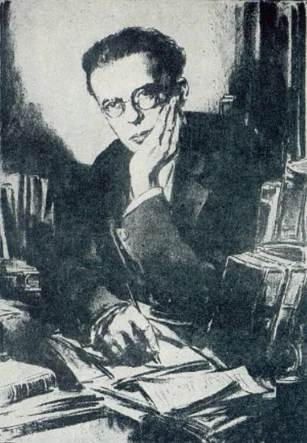
Aldous Huxley (1894-1963). Cartoon by Eric Pape (1870-1938), 1929. Courtesy Wikimedia Commons.
| Aldous Huxley | |
|---|---|
| Built-in | Aldous Leonard Huxley July 26 1894(1894-Template:MONTHNUMBER-26) Godalming, Surrey, England |
| Died | November 22 1963(1963-Template:MONTHNUMBER-22) (aged 69) Los Angeles, California] |
| Resting place | Compton]], Surrey]], England |
| Occupation | Author (fiction & non-fiction) |
| Notable work(s) | Dauntless New World,Isle, Point Counter Point, The Doors of Perception |
| Influences
| |
| Influenced
| |
| | |
| Signature | File:Aldous Huxley signature.svg |
Aldous Leonard Huxley (26 July 1894 - 22 November 1963) was an English poet, novelist, and non-fiction writer.
Contents
- ane Life
- 1.1 Overview
- 1.2 Youth and educational activity
- i.3 Career
- i.4 Bloomsbury prepare
- 1.5 The U.Southward.
- one.6 Post World War 2
- ane.7 Clan with Vedanta
- 1.8 Eyesight
- ane.nine Private life
- 1.10 Decease
- 2 Recognition
- 2.one Film adaptations of Huxley'south piece of work
- iii Publications
- 3.i Poetry
- 3.2 Novels
- 3.three Plays
- 3.4 Curt fiction
- 3.v Non-fiction
- 3.five.1 Travel
- three.5.2 Essays
- 3.6 Juvenile
- iii.7 Collected editions
- 3.8 Edited
- 3.9 Letters
- 3.10 Screenplays
- 4 Run across also
- 5 References
- 6 Notes
- 7 External links
Life [ ]
Overview [ ]
A prominent fellow member of the famous Huxley family unit, Huxley was best known for his novels including Brave New World and a broad-ranging output of essays, Huxley likewise edited the mag Oxford Poesy, and published short stories, poetry, travel writing, and pic stories and scripts. Huxley spent the afterwards office of his life in the Usa, living in Los Angeles from 1937 until his death.
Huxley was a humanist and pacifist, and he was latterly interested in spiritual subjects such as parapsychology and philosophical mysticism.[1] He is also well known for advocating and taking psychedelics.
By the end of his life Huxley was considered, in some academic circles, a leader of modern idea and an intellectual of the highest rank, and highly regarded as one of the most prominent explorers of visual communication and sight-related theories as well.[ii]
Youth and didactics [ ]
Huxley was born in Godalming, Surrey, UK, in 1894. He was the 3rd son of writer and schoolmaster Leonard Huxley and his 1st married woman, Julia (Arnold), who founded Prior's Field School. Julia was the niece of poet and critic Matthew Arnold and the sister of Mrs. Humphrey Ward. Aldous was the grandson of Thomas Henry Huxley, the zoologist, agnostic and controversialist ("Darwin's Bulldog"). His brother Julian Huxley and half-blood brother [Andrew Huxley too became outstanding biologists. Aldous had another blood brother, Noel Trevelyan (1891–1914), who committed suicide after a menstruum ofclinical depression.[3]
Huxley began his learning in his father's well-equipped botanical laboratory, so continued in a school named Hillside. His instructor was his mother who supervised him for several years until she became terminally ill. After Hillside, he was educated at Eton College. Huxley'due south female parent died in 1908 when he was 14. In 1911, he suffered an illness (keratitis punctata) which "left [him] practically bullheaded for 2 to three years".[four]
Aldous's near-blindness disqualified him from service in the Kickoff World War. Once his eyesight recovered sufficiently, he was able to study English literature at Balliol College, Oxford. In 1916 he edited Oxford Poetry and later graduated with first class honors. His brother Julian wrote,
I believe his blindness was a blessing in disguise. For ane thing, it put paid to his idea of taking upwardly medicine as a career.... His uniqueness lay in his universalism. He was able to take all noesis for his province.[5]
Career [ ]
Post-obit his teaching at Balliol, Huxley was financially indebted to his father and had to earn a living. He taught French for a year at Eton, where Eric Blair (afterwards to become George Orwell) and Stephen Runciman were amid his pupils, but was remembered as an incompetent and hopeless teacher who couldn't continue field of study. Nevertheless, Blair and others were impressed past his use of words.[half-dozen] For a short while in 1918, he was employed acquiring provisions at the Air Ministry.
Significantly, Huxley also worked for a fourth dimension in the 1920s at the technologically-avant-garde Brunner and Mond chemical plant in Billingham, Teesside, and the near recent introduction to his famous science fiction novel Brave New Globe (1932) states that this experience of "an ordered universe in a earth of planless incoherence" was a source for the novel.[7]
Huxley completed his earliest (unpublished) novel at the historic period of 17 and began writing seriously in his early 20s. His earliest published novels were social satires, first with Crome Yellow (1921).
Bloomsbury ready [ ]
Left to right: Bloomsbury Group members - Lady Ottoline Morrell, Maria Nys, Lytton Strachey, Duncan Grant, and Vanessa Bell.
During the Outset Globe State of war, Huxley spent much of his fourth dimension at Garsington Manor, home of Lady Ottoline Morrell, working every bit a farm labourer. Here he met several Bloomsbury figures including Bertrand Russell and Clive Bell. Later, in Crome Yellowish (1921) he caricatured the Garsington lifestyle. In 1919 he married Maria Nys, a Belgian woman he met at Garsington; they had one son. The family lived in Italy part of the time in the 1920s, where Huxley would visit his friend D. H. Lawrence. Post-obit Lawrence's death in 1930, Huxley edited Lawrence'southward letters (1933).
Works of this menstruum included of import novels on the dehumanizing aspects of scientific progress, most famously Brave New World, and on pacifist themes (for example, Eyeless in Gaza). In Brave New Earth Huxley portrays a society operating on the principles of mass production and Pavlovian conditioning. Huxley was strongly influenced past F. Matthias Alexander and included him every bit a graphic symbol in Eyeless in Gaza.
Starting from this menstruum, Huxley began to write and edit non-fiction works on pacifist issues, including Ends and Ways, An Encyclopedia of Pacifism, and Pacifism and Philosophy, and was an active member of the Peace Pledge Marriage.[8]
The U.S. [ ]
In 1937, Huxley moved to Hollywood, California, with his wife Maria, son Matthew, and friend Gerald Heard. He lived in the U.South., mainly in southern California, until his death, but also for a fourth dimension in Taos, New Mexico, where he wrote Ends and Means (published in 1937). In this piece of work he examines the fact that although well-nigh people in modern civilization hold that they want a world of "liberty, peace, justice, and brotherly dear", they accept not been able to agree on how to achieve information technology.
Heard introduced Huxley to Vedanta (Veda-Centric Hinduism), meditation, and vegetarianism through the principle of ahimsa. In 1938 Huxley befriended J. Krishnamurti, whose teachings he greatly admired. He also became a Vedantist in the circle of Hindu Swami Prabhavananda, and introduced Christopher Isherwood to this circle. Not long afterward, Huxley wrote his book on widely held spiritual values and ideas, The Perennial Philosophy, which discussed the teachings of renowned mystics of the globe. Huxley's book affirmed a sensibility that insists there are realities beyond the by and large accustomed "five senses" and that there is 18-carat meaning for humans beyond both sensual satisfactions and sentimentalities.
Huxley became a close friend of Remsen Bird, president of Occidental College. He spent much time at the college, which is in the Eagle Stone neighborhood of Los Angeles. The college appears as "Tarzana College" in his satirical novel After Many a Summer (1939). The novel won Huxley that year's James Tait Black Memorial Prize for fiction.[9] Huxley besides incorporated Bird into the novel.
During this period Huxley earned some Hollywood income every bit a author. In March 1938, his friend Anita Loos, a novelist and screenwriter, put him in touch with Metro-Goldwyn-Mayer who hired Huxley for Madame Curie which was originally to star Greta Garbo and be directed by George Cukor. (The pic was somewhen filmed past MGM in 1943 with a unlike managing director and stars.) Huxley received screen credit for Pride and Prejudice (1940) and was paid for his work on a number of other films, including Jane Eyre (1944).
However, his feel in Hollywood was non a success. When he wrote a synopsis of Alice in Wonderland, Walt Disney rejected it on the grounds that "he could only sympathise every third word".[10] Huxley'due south leisurely development of ideas, it seemed, was non suitable for the flick moguls, who demanded fast, dynamic dialogue above all else. For Dick Huemer, during the 1940s, Huxley went to the first of a five meetings' session to elaborate the script of Alice in Wonderland only never came again.[11] For writer John Grant, although the movie's character the Caterpillar displays some characteristics familiar from Huxley's discussion of his experiments with hallucinogens, Huxley's contribution to the motion picture is nonexistent.[12]
On 21 October 1949, Huxley wrote to George Orwell, author of Nineteen Eighty-Four, congratulating him on "how fine and how profoundly important the book is". In his letter to Orwell, he predicted:
- Within the next generation I believe that the globe'southward leaders volition detect that babe conditioning and narco-hypnosis are more efficient, equally instruments of authorities, than clubs and prisons, and that the lust for ability tin can be just every bit completely satisfied by suggesting people into loving their servitude as past flogging them and kick them into obedience.[13]
Postal service World State of war 2 [ ]
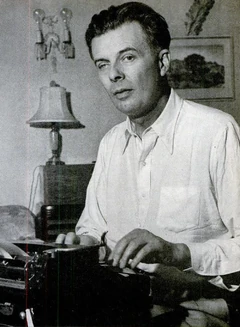
Aldous Huxley, from Life magazine, 1947. Courtesy Wikimedia Eatables.
After the Second Globe State of war, Huxley applied for U.s. citizenship. His application was continuously deferred on the grounds that he would not say he would accept up arms to defend the U.South. He claimed a philosophical, rather than a religious objection, and therefore was not exempt under the McCarran Act.[xiv] So, he withdrew his application. Nevertheless, he remained in the country, and in 1959 he turned downwards an offer of a Knight Bachelor by the Macmillan government. During the 1950s Huxley'south involvement in the field of psychical enquiry grew keener, and his later works are strongly influenced by both mysticism and his experiences with psychedelic drugs.
In October 1930, English occultist Aleister Crowley dined with Huxley in Berlin, and to this twenty-four hours rumours persist that Crowley introduced Huxley to peyote on that occasion. He was introduced to mescaline (considered to exist the key agile ingredient of peyote) past psychiatrist Humphry Osmond in 1953.[15] Through Dr. Osmond, Huxley met millionaire Alfred Matthew Hubbard who would deal with LSD on a wholesale basis.[16]
On 24 Dec 1955, Huxley took his beginning dose of LSD. Indeed, Huxley was a pioneer of self-directed psychedelic drug utilize "in a search for enlightenment", famously taking 100 micrograms of LSD equally he lay dying. His psychedelic drug experiences are described in the essays The Doors of Perception (the title deriving from some lines in the book The Spousal relationship of Sky and Hell past William Blake), and Heaven and Hell. Some of his writings on psychedelics became frequent reading among early hippies(Citation needed). While living in Los Angeles, Huxley was a friend of Ray Bradbury. According to Sam Weller'due south biography of Bradbury, the latter was dissatisfied with Huxley, especially afterwards Huxley encouraged Bradbury to accept psychedelic drugs.
Clan with Vedanta [ ]
Beginning in 1939 and continuing until his death in 1963, Huxley had an all-encompassing association with the Vedanta Society of Southern California, founded and headed by Swami Prabhavananda. Together with Gerald Heard, Christopher Isherwood, and other followers he was initiated by the Swami and was taught meditation and spiritual practices.
In 1944 Huxley wrote the introduction to the "Bhagavad Gita: The Vocal of God",[17] translated by Swami Prabhavanada and Christopher Isherwood, which was published by The Vedanta Lodge of Southern California.
From 1941 through 1960 Huxley contributed 48 articles to Vedanta and the W, published by the Club. He also served on the editorial board with Isherwood, Heard, and playwright John van Druten from 1951 through 1962.
Huxley also occasionally lectured at the Hollywood and Santa Barbara Vedanta temples. Two of those lectures accept been released on CD: Knowledge and Agreement and Who Are Nosotros from 1955.
Later the publication of The Doors of Perception, Huxley and the Swami disagreed about the meaning and importance of the LSD drug experience, which may accept caused the relationship to cool, merely Huxley continued to write articles for the Guild'south journal, lecture at the temple, and attend social functions.
Eyesight [ ]
With respect to details about the truthful quality of Huxley'southward eyesight at specific points in his life, there are differing accounts. Around 1939, Huxley encountered the Bates Method for better eyesight, and a teacher, Margaret Corbett, who was able to teach him in the method. In 1940, Huxley relocated from Hollywood to a ranchito in the high desert hamlet of Llano, California, in northernmost Los Angeles County. Huxley then said that his sight improved dramatically with the Bates Method and the extreme and pure natural lighting of the southwestern American desert. He reported that for the showtime fourth dimension in over 25 years, he was able to read without glasses and without strain. He even tried driving a car forth the dirt road beside the ranch. He wrote a book about his successes with the Bates Method, The Fine art of Seeing, which was published in 1942 (U.s.), 1943 (U.k.). Information technology was from this period, with the publication of the generally disputed theories contained in the latter volume, that a growing caste of popular controversy arose over the subject of Huxley's eyesight.
It was, and to a noticeable extent nevertheless is, widely held that, for most of his life, since the illness in his teens which left Huxley nearly blind, that his eyesight was exceedingly poor (despite the fractional recovery which had enabled him to written report at Oxford). For instance, some 10 years subsequently publication of The Art of Seeing, in 1952, Bennett Cerf was present when Huxley spoke at a Hollywood banquet, wearing no spectacles and patently reading his paper from the lectern without difficulty: "Then suddenly he faltered — and the disturbing truth became obvious. He wasn't reading his address at all. He had learned it by heart. To refresh his memory he brought the paper closer and closer to his eyes. When information technology was only an inch or and so away he still couldn't read information technology, and had to fish for a magnifying glass in his pocket to brand the typing visible to him. It was an agonizing moment."[18]
On the other hand, Huxley's second married woman, Laura Archera Huxley, would afterward emphasize in her biographical account, This Timeless Moment: "I of the smashing achievements of his life: that of having regained his sight." Here, she portrays the accomplishment equally both metaphorical and considerably physiological in nature, attributing that which she cites J. Krishnamurti equally naming the spirit of "liberty from the known", which she suggests that Huxley applied, non-exhaustively, in writing The Art of Seeing and utilizing the Bates Method. Afterward revealing a alphabetic character she wrote to the Los Angeles Times disclaiming the label of Huxley equally a "poor fellow who can hardly come across" by Walter C. Alvarez, she tempers this: "Although I feel information technology was an injustice to treat Aldous as though he were bullheaded, it is truthful there were many indications of his impaired vision. For case, although Aldous did not wear glasses, he would quite ofttimes use a magnifying lens."[nineteen] Laura Huxley proceeds to elaborate a few nuances of inconsistency peculiar to Huxley's vision. Her account, in this respect, is discernibly congruent with the following sample of Huxley's own words from The Art of Seeing. "The most feature fact virtually the performance of the full organism, or any part of the organism, is that it is not constant, but highly variable." Nevertheless, the topic of Huxley'due south eyesight continues to endure similar, significant controversy, regardless of how piddling a subject matter it might initially announced.[twenty]
Private life [ ]
He married Maria Nys (10 September 1899 - 12 February 1955), a Belgian he met at Garsington, in 1919. They had a kid, Matthew Huxley (nineteen Apr 1920 - 10 February 2005), who had a career as an writer, anthropologist, and prominent epidemiologist.[21] In 1955, Maria died of breast cancer.
In 1956 he married Laura Archera (1911–2007), besides an writer. She wrote This Timeless Moment, a biography of Huxley. In 1960 Huxley himself was diagnosed with laryngeal cancer, and in the years that followed, with his health deteriorating, he wrote the Utopian novel Island,[22] and gave lectures on "Man Potentialities" at the Esalen plant, which were primal to the forming of the Man Potential Motion.
Death [ ]
On his deathbed, unable to speak, Huxley made a written request to his wife Laura for "LSD, 100 µg, intramuscular". According to her business relationship of his expiry[23] in This Timeless Moment, she obliged with an injection at xi:45 am and another a couple of hours later. He died, aged 69, at 5:20 pm on 22 November 1963, several hours after the bump-off of John F. Kennedy. Huxley'due south ashes were interred in the family grave at the Watts Cemetery, dwelling of the Watts Mortuary Chapel in Compton, a village near Guildford, Surrey, England.[24]
Media coverage of Huxley's passing was overshadowed by the assassination of President John F. Kennedy, on the aforementioned mean solar day, and the death of the British author C.S. Lewis, who also died on 22 November. This coincidence was the inspiration for Peter Kreeft'south book Between Heaven and Hell: A Dialog Somewhere Beyond Death with John F. Kennedy, C. S. Lewis, & Aldous Huxley. Huxley'south literary legacy continues to be represented by the literary agency headed by Georges Borchardt.
Recognition [ ]
- 1939 James Tait Black Memorial Prize for After Many a Summer Dies the Swan.
- 1959 Aldous Huxley American University of Arts and Letters Award of Merit for Brave New Globe.
- 1962 the Companion of Literature by the Royal Society of Literature.[25]
Picture show adaptations of Huxley's piece of work [ ]
- 1968 Bespeak Counter Betoken BBC mini-series by Simon Raven.
- 1971 The Devils (Ken Russell) adapted Huxley'southward The Devils of Loudun.
- 1998 US TV adaptation of Brave New Globe
Publications [ ]
Poesy [ ]
- The Burning Wheel. Oxford: Blackwell, 1916.
- Jonah. Oxford: Holywell Press, 1917.
- The Defeat of Youth, and other poems. Oxford: Blackwell, 1918.
- Leda. London: Chatto & Windus, 1920; New York: Doran, 1920; Garden Urban center, NY: Doubleday Doran, 1929.
- Selected Poems. Oxford: Blackwell, 1925; New York: Appleton, 1925.
- Arabia Infelix, and other poems. London: Chatto & Windus, 1929; New York: Fountain Printing, 1929.
- The Cicadas, and other poems. London: Chatto & Windus, 1931; Garden City, NY: Doubleday, Doran, 1931.
- Nerveless Poetry (edited past Donald Watt & Richard Church). London: Chatto & Windus, 1971; New York: Harper, 1971.
Novels [ ]
- Crome Yellowish. London: Chatto & Windus, 1921; New York: Harper, 1922.
- Antic Hay. London: Chatto & Windus, 1923; New York: Doran, 1923.
- Those Arid Leaves. London: Chatto & Windus, 1925; New York: Doran, 1925.
- Indicate Counter Signal. London: Chatto & Windus, 1928; New York: Doran, 1928.
- Brave New World. London: Chatto & Windus, 1932; New York: Harper, 1932.
- Eyeless in Gaza. London: Chatto & Windus, 1936; New York: Harper, 1936.
- After Many a Summer. London: Chatto & Windus, 1939; Toronto: Macmillan, 1939.
- Fourth dimension Must Have a Stop. New York: Harper, 1944; London: Chatto & Windus, 1945.
- Ape and Essence. New York: Harper, 1948; London: Chatto & Windus, 1949.
- The Devils of Loudun. New York: Harper, 1952; London: Chatto & Windus, 1952.
- The Genius and the Goddess. New York: Harper, 1954; London: Chatto & Windus, 1955.
- Heaven and Hell. New York: Harper, 1955; London: Chatto & Windus, 1956.
- Island. New York: Harper, 1962; London: Chatto & Windus, 1962.
Plays [ ]
- The Discovery: A comedy in 5 acts (adapted from Francis Sheridan). London: Chatto & Windus, 1924; New York: Doran, 1925.
- The World of Lite: A comedy in iii acts. London: Chatto & Windus, 1931.
- The Gioconda Smile: A play. New York: Harper, 1948; London: Chatto & Windus, 1948.
- Now More than Than Always: An edition (edited by David Bradshaw & James Sexton). Austin, TX: University of Texas Printing, 2000.
Curt fiction [ ]
- Limbo. London: Chatto & Windus, 1920; New York: Doran, 1920.
- Mortal Coils, and other stories. London: Chatto & Windus, 1922.
- Little Mexican, and other stories . London: Chatto & Windus, 1924
- published in U.S. every bit Young Archimedes, and other stories. New York: Doran, 1924.
- Two or Three Graces: Four stories. London: Chatto & Windus, 1926.
- Brief Candles: Stories. London: Chatto & Windus, 1930.
- Collected Short Stories]]. London: Chatto & Windus, 1936; New York: Harper, 1937.
Non-fiction [ ]
- Vulgarity in Literature: Digressions from a theme. London: Chatto & Windus, 1930.
- Pacifism and Philosophy. London: Allensen, 1936; London: Peace Pledge Union, 1984.
- The Perennial Philosophy. New York & London: Harper, 1945; London: Chatto & Windus, 1946.
- Grey Eminence: A study in religion and politics. New York: Harper, 1941; London: Chatto & Windus, 1941.
- The Art of Seeing. London: Chatto & Windus, 1943.
- The Doors of Perception / Heaven and Hell. New York: Harper, 1954; London: Chatto & Windus, 1954.
- Brave New World Revisited. New York: Harper, 1958.
- On Art and Artists. New York: Harper, 1960.
Travel [ ]
- Along The Route: Notes and essays of a tourist. London: Chatto & Windus, 1925; New York: Doran, 1925; London: Flamingo, 1994.
- Jesting Pilate: The Diary of a Journey. London: Chatto & Windus, 1930.
- Beyond the Mexique Bay: A Traveller'southward Journey. London: Chatto & Windus, 1934; New York: Harper, 1934.
Essays [ ]
- On the Margin. London: Chatto & Windus, 1923; New York: Doran, 1923.
- New and One-time Essays. London: Chatto & Windus, 1926; New York: Doran, 1926.
- Proper Studies. London: Chatto & Windus, 1927; Garden City, NY: Doubleday Dorn, 1928.
- Do What You Volition: Essays. London: Chatto & Windus, 1929.
- Holy Face, and other essays. London: Curwen Press, for The Fleuron, 1929.
- Music at Night, and other essays. London: Chatto & Windus, 1931.
- Texts and Pretexts: An anthology with commentaries. London: Chatto & Windus, 1932; New York: Harper, 1932.
- The Olive Tree, and other essays. London: Chatto & Windus, 1936.
- Ends and Ways. London: Chatto & Windus, 1939; New Brunswick, NJ: Transaction, 201; London: Taylor & Francis, 2017.
- Words and their Meanings. Los Angeles: Ward Richie Press, 1940.
- Science, Liberty and Peace. New York: Harper, 1946.
- Themes and Variations. London: Chatto & Windus, 1950; Freeport, NY: Books for Libraries Press, 1970.
- Adonis and the Alphabet, and other essays. London: Chatto & Windus, (1956)
- published in the U.S. as Tomorrow and Tomorrow and Tomorrow, and other essays. New York: Harper, 1956.
- Nerveless Essays. New York: Harper, 1958.
- Literature and Science. New York: Harper, 1963.
- The Human Situation: Lectures at Santa Barbara, 1959. New York: Harper, 1977; London: Chatto & Windus, 1977; London: Flamingo, 1994; London: Triad, 2012.
- Pacifism and philosophy: Selected talks and writings 1935-1947. London: Peace Pledge Union, 1984.
- Moksha: Writings on Psychedelics and the Visionary Experience 1931-63. London: Chatto & windus, 1977; New York: Stonehill, 1977; London: Flamingo, 1994; Rochester, VT: Inner Traditions, 1999.
- Complete Essays. (six volumes), Chicago: Ivan R. Dee, 2000-2002. Vol I, 1920-1925, Vol. 2: 1926-1929, Vol. Three: 1930-1935, Vol. 4: 1936-1938, Vol. V: 1938-1956, Vol 6: 1956-1963
Juvenile [ ]
- The Crows of Pearblossom (illustrated past Barbara Cooney). London: Chatto & Windus, 1967; New York: Random House, 1967.
Collected editions [ ]
- Rotunda: A selection from the works of Aldous Huxley. London: Chatto & Windus, 1932.
- Stories, Essays, and Poems. London: Dent, 1942.
- Verses and a One-act. London: Chatto & Windus, 1946.
- The World of Aldous Huxley: An omnibus of his fiction and non-fiction over three decades (edited by Charles J. Rolo). New York: Grosset, 1947.
- Collected Works. London: Chatto & Windus, 1957.
- Limbo: Vi stories and a play. London: Chatto & Windus, 1962.
Edited [ ]
- Oxford Poetry 1917 (edited with Wilfred Rowland Childe; TW Earp, & Dorothy 50. Sayers) Oxford: Blackwell, 1918.
- An Encyclopedia of Pacifism. London: Chatto & Windus, 1937; New York: Garland, 1972.
Letters [ ]
- Letters. New York: Harper & Row, 1969.
- Selected Messages (edited by James Sexton). Chicago: Ivan R. Dee, 2007.
Except where noted, bibliographical information courtesy Huxley.cyberspace ,[26] and WorldCat .[27]
Screenplays [ ]
- Brave New Globe
- Ape and Essence
- Pride and Prejudice (Collaboration. 1940)
- Madame Curie (Collaboration. 1943)
- Jane Eyre (Collaboration with John Houseman. 1944)
- A Woman's Vengeance 1947
- Original screenplay for Disney's animated Alice in Wonderland 1951 (rejected) [28]
- Eyeless in Gaza BBC Mini-serial (Collaboration with Robin Chapman. Aired 1971)[29]
Behemoth past Aldous Huxley Poetry Audiobook
Run into likewise [ ]
- Listing of British poets
References [ ]
Escape by Aldous Huxley Verse Audiobook YouTube

On Beauty ~ A "institute poem," in the words of Aldous Huxley-0
- John Atkins, Aldous Huxley: A Literary Report, J. Calder, 1956
- Nicholas Murray, Aldous Huxley, Macmillan, 2003, ISBN 0312302375
- Laura Archera Huxley, This Timeless Moment, Celestial Arts, 2001, ISBN 0890879689
- Sybille Bedford, Aldous Huxley: A Biography, Harper and Row, 1974, rev. ed., Ivan R. Dee, 2002 ISBN 1566634547
- James Sexton (ed.), Aldous Huxley: Selected Letters, Ivan R. Dee, 2007, ISBN 1566636292
- David Male monarch Dunaway, Huxley in Hollywood, HarperCollins 1990, ISBN 0385415915
- Aldous Huxley, The Homo Situation: Aldous Huxley Lectures at Santa Barbara 1959, Flamingo Modernistic Archetype, 1994, ISBN 0006547327
- Conrad Watt (ed.), Aldous Huxley, Routledge, 1997, ISBN 0415159159
- Dana Sawyer, Aldous Huxley, Crossroad Publishing Co., 2002, ISBN 0824519872
- Jerome Meckier, Aldous Huxley: mod satirical novelist of ideas, Firchow and Nugel editors, LIT Verlag Berlin-Hamburg-Münster, 2006, ISBN 3825896683
Notes [ ]
- ↑ David Male monarch Dunaway (1998) Aldous Huxley recollected: an oral history p.90. Rowman Altamira, 1998
- ↑ Thody, Philipe (1973). Huxley: A Biographical Introduction. Scribner. ISBN 0289701880.
- ↑ Holmes, Charles Stonemason (1978) Aldous Huxley and the Fashion to Reality p.five. Greenwood Printing, 1978
- ↑ Huxley, Aldous (1939). "biography and bibliography (appendix)". After Many A Summer Dies The Swan (1st Perennial Classic Ed.). Harper & Row, Publishers. p. 243.
- ↑ Julian Huxley 1965. Aldous Huxley 1894–1963: a Memorial Volume. Chatto & Windus, London. p22
- ↑ Crick, Bernard (1992). George Orwell: A Life. London: Penguin Books. ISBN 014014563X.
- ↑ Baggini, Julian (2009) Atheism, A Brief insight Sterling Publishing Visitor, Inc., 2009
- ↑ "Aldous Huxley". Peace Pledge Spousal relationship. http://world wide web.ppu.org.united kingdom/people/huxley.html . Retrieved 2011-05-15.
- ↑ Haugrud Reiff, Raychel (2003) Aldous Huxley: Brave New World p.103. Marshall Cavendish, 2009
- ↑ Clark, Ronald William (1968). The Huxleys. New York: McGraw-Hill. p. 295. ISBN 0434135801.
- ↑ Template:En David Koenig, Mouse Nether Glass, p.82
- ↑ Template:En John Grant, The Encyclopedia of Walt Disney's Animated Characters, p.233.
- ↑ Huxley, Aldous (1969). Grover Smith. ed. Letters of Aldous Huxley. London: Chatto & Windus. ISBN 070111312X.
- ↑ Template:Cite document
- ↑ Martin, Douglas. Friday, 22 August 2008 "Humphry Osmond, 86, Who Sought Medicinal Value in Psychedelic Drugs, Dies". New York: New York Times
- ↑ Stevens, Jay (1998). Storming heaven: LSD and the American dream. Grove Press. pp. 47–64. ISBN 0802135872. http://books.google.com/?id=rKlGAdNUDAkC&pg=PA47&dq=Storming+sky+Noonday+Sun#5=onepage&q=. "All sorts of crazy things started happening..."
- ↑ Isherwood, Christopher; Swami Prabhavananda; Aldous, Huxley (1987). Bhagavad Gita: The Song of God. Hollywood, Calif: Vedanta Printing. ISBN 978-0-87481-043-1.
- ↑ From Bennet Cerf'southward column in The Saturday Review, 12 April 1952, quoted in Gardner, Martin (1957). Fads and Fallacies in the Name of Scientific discipline . Dover Publications. ISBN 0-486-20394-8.
- ↑ Huxley, Laura (1968). This Timeless Moment. New York: Farrar, Straus & Giroux. ISBN 0890879680.
- ↑ Rolfe, Lionel (1981) Literary L.A. p.l. Chronicle Books, 1981. University of California
- ↑ "Author, NIMH Epidemiologist Matthew Huxley Dies at 84". Feb 17, 2005 Washington Post
- ↑ Peter Bowering Aldous Huxley: A Study of the Major Novels, p. 197, Oxford University Press, 1969
- ↑ Account of Huxley'south death on Letters of Note
- ↑ Aldous Huxley at Find a Grave
- ↑ Chevalier, Tracy (1997). Encyclopedia of the Essay. Routldge. p. 416. ISBN i-57958-342-iii.
- ↑ Nicholas Murray, Aldous Huxley Bibliography, Huxley.cyberspace. Web, July 20, 2020.
- ↑ Search results = Aldous Huxley, WorldCat, OCLC Online Figurer Library Heart Inc. Web, July 20, 2020.
- ↑ Bradshaw, David (1993). "Introduction". Aldous Huxley'due south "Those Barren Leaves" (Vintage Classics Edn., 2005). Vintage, Random House, 20 Vauxhall Brigade Route, London. xii.
- ↑ http://www.imdb.com/title/tt0346956/combined
External links [ ]
- Poems
- Aldous Huxley at AllPoety (42 poems)
- Aldous Huxley at PoemHunter (43 poems)
- Audio / video
- BBC discussion programme In our time: "Dauntless New World". Huxley and the novel. 9 Apr 2009. (Audio, 45 mins)
- BBC In their ain words series. 12 Oct 1958. (Video, 12 mins).
- "The Ultimate Revolution" (talk at UC Berkeley, 20 March 1962)
- Huxley interviewed on The Mike Wallace interview 18 May 1958. (Video)
- Books
- OLOL19767A
- Works by Aldous Huxley at Project Gutenberg
- Aldous Huxley at Amazon.com
- Aldous Huxley at Goodreads
- Works by or about Aldous Huxley in libraries (WorldCat itemize)
- About
- Aldous Huxley in the Encyclopædia Britannica
- Aldous Huxley at Biography.com
- Raymond Fraser, George Wickes (Spring 1960). "Interview: Aldous Huxley: The Fine art of Fiction No. 24". The Paris Review . http://world wide web.theparisreview.org/interviews/4698/the-fine art-of-fiction-no-24-aldous-huxley.
- Centre for Huxley Inquiry
| Persondata | |
|---|---|
| Name | Huxley, Aldous |
| Alternative names | Huxley, Aldous Leonard |
| Curt clarification | Writer; author |
| Date of birth | 26 July 1894 |
| Place of nativity | Surrey, England |
| Engagement of death | 22 November 1963 |
| Place of expiry | Los Angeles, California, Us |
Source: https://pennyspoetry.fandom.com/wiki/Aldous_Huxley
0 Response to "The Art of Seeing Exploration of Bates Method of Vision Improvement Aldous Huxley Goodreadscom"
Post a Comment